I wiped Fedora 44, installed Omarchy, and set about recovering the workstation I had spent months teaching to be useful. Projects, SSH access, agent configs, the memory in cairnkeep. The important things came back from the NAS. Then I reached the large, replaceable things: the model weights.
That seemed like a good time to question the default. My RTX 5090 had been running a 27B with NVFP4 KV cache. Could Qwen3.8-Flash-Next become the local coding model on this box instead?
The requirements were concrete: one 32 GB RTX 5090, 96 GB of system RAM, native 256K context, and enough headroom to keep using the desktop. I wanted working code and tool calls in OpenCode. A fast answer to a tiny prompt was useful evidence, but it would not settle the decision.
NVFP4 looked like a sensible candidate for a Blackwell GPU. A higher-precision GGUF looked attractive on published quality charts. I had a coding agent run the experiments rather than choosing from the filenames.
The first recommendation was NVFP4. The model I eventually kept was Unsloth UD-IQ4_XS-v31. The reason starts with a date.
The quant I tested was older than the guide I was reading
The initial comparison used Strata’s existing Unsloth downloads. Then I read the current Unsloth guide, which announced Dynamic v3.1 on November 4.
My installed files came from the September 30 revision. Same model family, familiar quant names, a different candidate from the one in the new charts. That is an easy way to finish a careful benchmark and answer yesterday’s question.
There was a second trap: a changed download did not necessarily mean changed weights. The Strata 0.2.11 release notes distinguish the cases explicitly. The November Q4_K_XL upload contains the same weights with different shard boundaries. IQ4_XS-v31 has different tensor formats and four shards instead of three. It gets a separate model name.
So I updated Strata and downloaded v3.1 separately. The fresh comparison used CLI 0.2.11, control and engine 0.1.57, for both candidates. NVFP4 got a fresh run too. Carrying its old score across the engine update would have added another variable to the comparison.
The pinned revisions were:
| Candidate | Repository revision |
|---|---|
| Unsloth IQ4_XS-v31 | d96201194f103c906994f283f504209dc8d2a10c |
| Maximilian228 NVFP4-GPTQ Strata pack | 640a1db97446ddd5e89d2b70ecd0297987192c93 |
What I actually held constant
This is a comparison of two working deployments on my workstation. Each pack still brings its own precision and storage choices. It is not a clean laboratory isolation of weight format alone.
Strata makes this a GPU-and-host-RAM deployment. The weights extend well beyond the card’s 32 GB, so host residency and the prepared pack are part of the memory budget. That is why I measured available system RAM alongside the GPU configuration.
The shared settings were:
- RTX 5090 with a 450 W power limit, the same cap for every run.
- Native 262,144-token context, int8 KV, one slot, vision disabled.
- MTP drafting, four draft tokens, minimum acceptance probability 0.5.
- A 3,072 MiB VRAM reserve and route-tail skipping disabled.
- One model loaded at a time, weights on the local NVMe, tuning skipped.
The model-specific paths matter too: v3.1 used STRATA_HC_Q8=1; the NVFP4
deployment used STRATA_PREFILL_NVFP4=w4a8. Those settings belong with the
results. A format name does not describe every operation the engine performs.
The 450 W cap is an operating choice from this machine’s history with GPU instability. These measurements do not describe an unrestricted 600 W card. They also do not certify months of agent-session stability.
A small suite that could tell me when the answer was wrong
I wanted executable checks. The core suite had 16 cases, covering Python code, structured output, tool arguments, context records, and small repair tasks with read/write/test tools. SSE chunk handling, exact decimal accounting, and a bounded asynchronous mapper were among the coding tasks.
Each candidate ran those cases directly and again with thinking enabled. That is the same 16 cases under two modes, not 32 independent problems. The output budget was 4,096 tokens per request.
Then came a frozen 32-problem subset of
HumanEval, selected with seed
20261105. All selected reference solutions had passed the local grader.
Generated code ran in bubblewrap with no network or home-directory access,
plus CPU, memory, file-size and wall-time limits.
Finally, six selected cases got another run with a larger, 8,192-token
budget and the reasoning/sampling settings described by Unsloth: temperature
1.0, top_p=0.95, top_k=20, min_p=0, no presence or repetition penalty,
xhigh reasoning, and preserved thinking. The harness retained assistant
reasoning on tool continuations; I also checked that the template rendered it.
Each of those six cases used one seeded sample.
Those focused reruns are useful diagnostics. They are a very long way from Unsloth’s broad, repeated agentic evaluation. Their guide uses native 256K for agentic benchmarks too; it does not establish a 512K agent-quality result.
The fresh results
| Measurement | IQ4_XS-v31 | NVFP4-GPTQ |
|---|---|---|
| Core direct checks | 16/16 | 16/16 |
| Same checks with thinking | 16/16 | 16/16 |
| Frozen HumanEval subset | 31/32 | 31/32 |
| Six focused recommended-settings reruns | 6/6 | 5/6 |
| Short-prompt decode, median of three runs | 175.7 tok/s | 145.3 tok/s |
Minimum sampled system MemAvailable | 14.6 GiB | 6.7 GiB |
| Near-full 256K three-marker recall | Pass | Pass |
| Near-full-context time to first token | 40.84 s | 41.37 s |
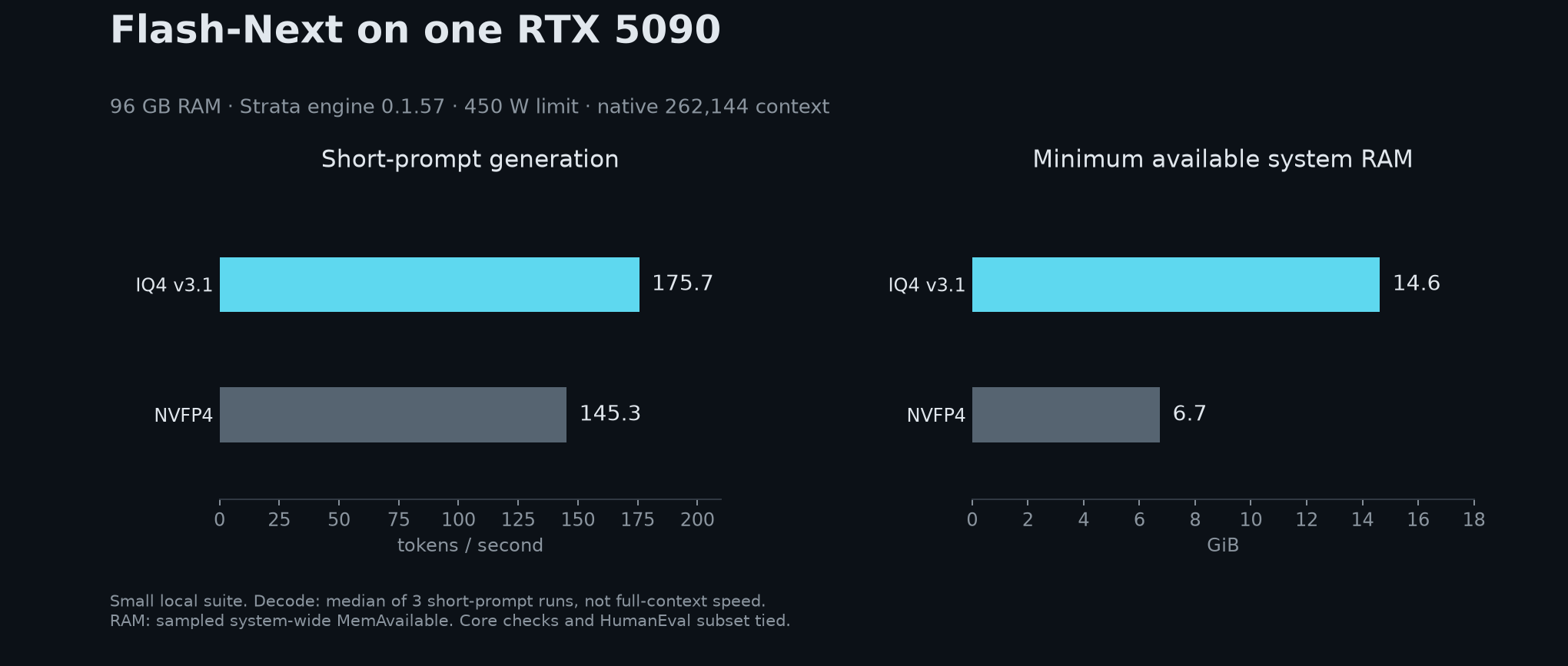
The decode measurement used short prompts and up to 512 output tokens at temperature 0.6, with a warm-up excluded. 176 tok/s is not a measured generation rate at a full 256K context. The RAM figure is system-wide available memory sampled during the tests, including the desktop and OS; it is not isolated model RSS.
The quality difference needs similar restraint. Both candidates failed the
same HumanEval problem, number 127, on interval-intersection length. In the
focused reruns, NVFP4 generated an accounting implementation with an
uninitialized local variable. The test raised UnboundLocalError. The
response had finished within its token budget; this was an implementation
bug, rather than an answer cut off by the harness.
That one failure does not establish a general quality ranking. What it gave me was a practical result: the new quant showed no deficit in the core checks, passed the focused rerun, generated about 21% faster in the short-prompt test, and left nearly 8 GiB more RAM available.
That last column matters when this is also the machine on which I browse, edit, and run the coding agent. I wanted a usable workstation around the model.
Filling the context instead of admiring the allocation
A server accepting --context 256k proves that a configuration loaded.
I also wanted to know whether it could answer with the window nearly full.
Both candidates received a synthetic prompt with markers near the beginning, middle and end. The API reported 256,553 prompt tokens for each. Both returned all three markers, with the first answer token arriving in roughly 41 seconds.
That is a recall smoke test. It establishes something useful about this configuration, but three recovered strings cannot certify long-context coding quality. I have not measured a sustained agent session at that depth, and a short-prompt throughput number cannot fill that gap.
I kept native 256K as the daily setting. YaRN at 512K remains a separate experiment for the selected v3.1 deployment. More addressable context would need its own quality, latency and headroom checks before becoming my default.
Where Q4_K_XL fits into the story
Q4_K_XL was part of the earlier experiment. On this 96 GB host, a full-residency trial crossed the minimum-RAM guard and was stopped. A budgeted configuration ran, using a 64 GiB expert-residency budget.
Those runs used engine 0.1.56. Their scores belong with those settings; the fresh table above is the two-candidate comparison on 0.1.57. The November Q4 resharding also does not turn the earlier weights into a new quantization algorithm.
Published quality charts helped me choose what to try. My final choice had to include the host-memory budget, engine path, context requirement and desktop workload. A nominally higher-precision download can be a perfectly reasonable choice on a different machine. Here, v3.1 was the deployment I wanted to keep.
The configuration I kept
These are the launch choices used for the selected candidate; the first run downloads and prepares the model. This recipe is scoped to the versions above:
strata launch \
  --family unsloth --model UD-IQ4_XS-v31 \
  --context 256k --kv int8 --parallel 1 --vision off \
  --drafting mtp --tune skip --access local \
  --data-dir "$HOME/data/strata" \
  --set vram-reserve-mib=3072 \
  --set spec=4 --set spec-min-p=0.5 \
  --set STRATA_ROUTE_TAIL_SKIP=0 \
  --set STRATA_HC_Q8=1 \
  --save-preset "Flash Next IQ4 v31 256K" \
  --yes --no-tui
If another model is already serving, stop it first with strata launch --stop.
For later starts, use the saved preset:
strata launch --preset "Flash Next IQ4 v31 256K" --no-tui
I also kept a small identity check close at hand:
curl -fsS http://127.0.0.1:8080/v1/models | python -m json.tool
OpenCode now has one local Strata entry for the selected model, pointing at
http://127.0.0.1:8080/v1, with tool calling and reasoning enabled. Its
configured context is 262,144 tokens. The endpoint check tells me what is
actually loaded when I come back to the machine.
One model on NVMe, the experiments on the NAS
The remaining cleanup was pleasantly concrete: keep the selected model and its required pack local, move the old IQ4, Q4_K_XL, NVFP4 and retired 27B weights and their unused model-specific packs to the NAS. The move freed about 353 GB on the NVMe; the old paths now point to the NAS copies. The shared MTP files stay local.
There was one final lesson about automation budgets. My agent initially gave every model a full source SHA256 pass, a copy, and a complete read-back hash over the NAS link. That is a lot of network time for public weights whose recovery procedure is to download them again. After the first model, I changed the remaining moves to rsync’s transfer checks plus file-list and size validation, retaining the source-unchanged check before local removal. The encrypted backups of configurations and agent memory deserve a different standard from replaceable downloads.
The conclusion I can support is deliberately local: IQ4_XS v3.1 is the Flash-Next deployment I kept for this RTX 5090, 96 GB of RAM and a native 256K coding context. The measurements leave me a comfortable reason to use it, and a versioned baseline for the next candidate.
The measurement data and runnable test bundle include the task selection, settings and limitations. If a newer engine changes the answer, there is something concrete to rerun.