Attention fails before the guard does
Five measurements from driving a real coding-agent session past a half-million-token window, and what each one changes about how I run agents.
Every claim I’ve made about context management — promotion, compaction, “persist before pruning” — has been theory: it composes on paper, nobody has watched it happen under genuine load. My fleet serves a local model with a 524,288-token window, my agent harness (omp) has context machinery I’ve never seen fire, and my memory policy asks agents to write durable notes before material leaves context — but when does material actually leave?
So fleet-brain, the cross-repo index project I wrote about before, grew a
second purpose: a harness that drives a real omp --mode rpc session past
the boundary with no manual rescue, logging every turn’s context size, every
promotional jump, every compaction, and every durable-memory write. Each turn
makes the agent read a large real doc in full and analyze it — honest load,
not lorem ipsum. Every workload turn also injects a unique canary token
(CANARY-014-ZEPHYR82), and every few turns a probe asks the agent, tools
locked: which canaries can you still literally see? Which file did turn one
cover? Gist versus verbatim, measured.
Five results. Each one changed something I do.
1. Promotion fires early and rides the cache
Session one, defaults on. Context grew 11K → 442K over 24 turns; at
445,432 tokens — 85% of the window — the harness switched the session to
the cloud promotion target and kept going: 546,631 tokens, 140% of the
local window, no error, no rescue, no compaction. The crossing turns show
457K–539K of the prompt arriving as cacheRead: the cloud tier didn’t
re-prefill my history, it picked up a cached context and kept growing it.
Turn latency after the jump: 24–40 seconds.
The design point: promotion fires before the wall, not at it. The switch cost is paid while there is still slack, so an over-budget request can never fail. I had assumed the opposite — that machinery triggers on overflow. It triggers on approach.
2. Compaction destroys verbatim, preserves gist
Second session, promotion disabled via config overlay, so something had to
give. Nothing crashed and — surprise #1 — no token was ever withheld.
Instead, at 445,681 tokens (again 85%), the harness ran a snapcompact:
76,459 characters of history archived onto five summary frames. Presented
context: 445,681 → 44,979. A 90% cut. Session continued, epoch bumped,
context grew back, and at the next 85% it happened again.
The canaries say what that 90% lost:
| generation | oldest-4 canaries | newest canaries | turn-1 file path |
|---|---|---|---|
| before any compaction | present | present | recalled |
| after one compaction | LOST, every probe | present | recalled |
Verbatim strings do not survive summarization. High-entropy tokens — IDs, secrets, exact numbers, the literal content of a diff — die first, every time. The structure survives: which files were read, what they cover, which decision followed which. Compaction is a gist-preservation machine.
Which is exactly why “persist before pruning” is the right policy: durable memory entries have to be written while the verbatim detail is still in context, because after compaction the agent still knows what happened but can no longer quote it. My memory-hygiene rule now has a mechanism behind it.
3. The headline: recall collapses before any machinery fires
Third session, promotion back on, pushed further — toward the cloud model’s own 1M window. One promotion, at 84% of the local window; the target re-tokenized the intact history (445K → 426K tokens, different tokenizer, no summarization) and kept growing to 732,088 — with zero compactions and zero further model changes. No thrash: the promotion target is terminal. A follow-up run closed the last open question: driven deeper, the cloud model grew to 848,598 and ran its own snapcompact there — so the relief threshold is proportional to whatever window you are currently in, and the 85% promotion point proved deterministic across runs to within ~10 tokens. The canary curve below reproduced on the second run almost exactly (7/8 at 364K → 3/8 at 453K → flat to 805K, gist perfect). The cliff is not noise.
And here is the result I did not predict. Look at the canary curve — nothing has happened the entire time. No compaction, no promotion after turn 22, every token still formally in context:
| probe | context size | oldest canaries survived |
|---|---|---|
| 8 | 237K | yes (7/7) |
| 16 | 389K | yes (8/8) |
| 24 | 443K | no (4/8 — oldest four LOST) |
| 32–48 | 517K → 664K | never recovered, even on the cloud model |
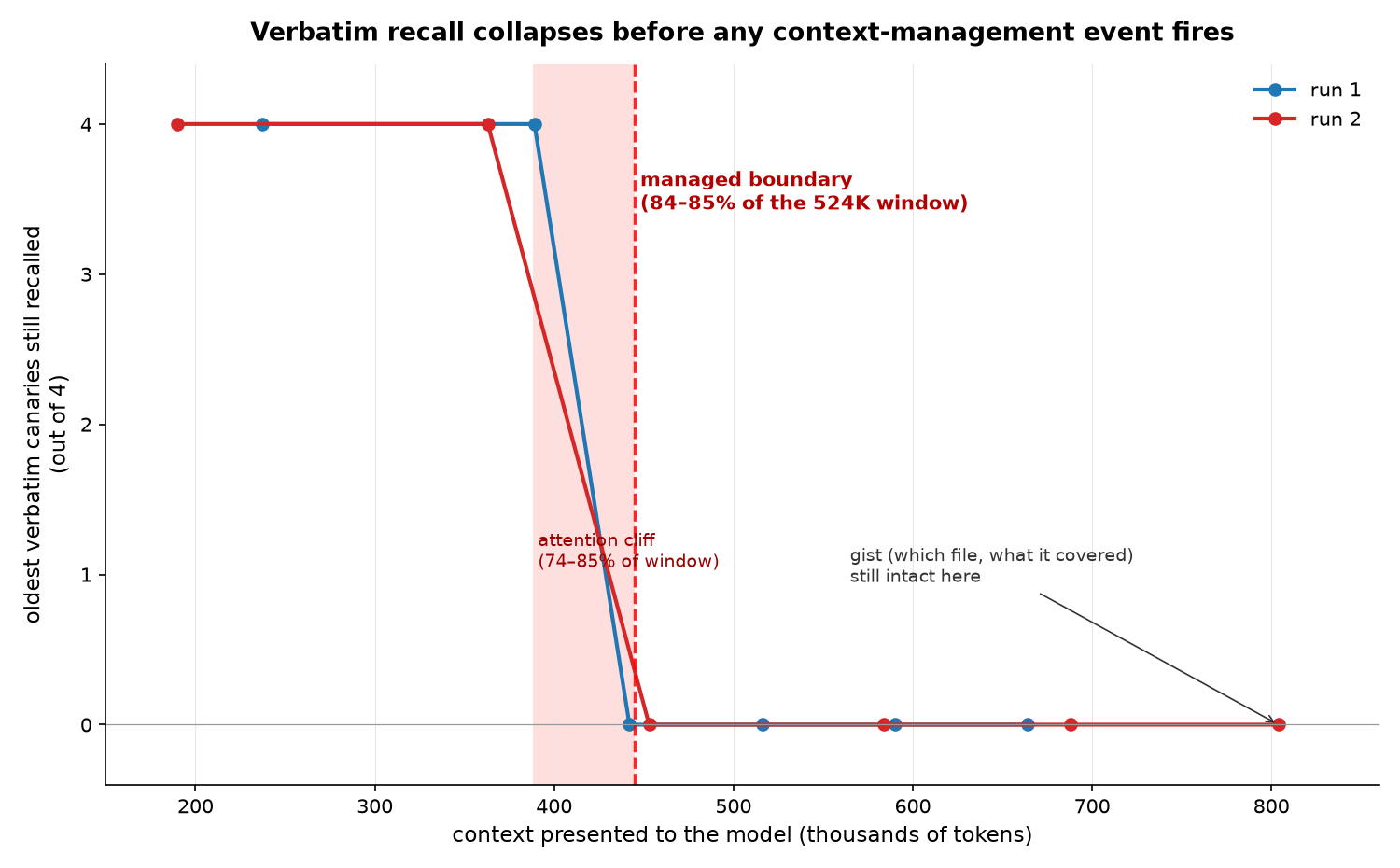
Between 389K and 443K — 74% to 85% of the window — the agent stopped being able to see the oldest verbatim content, while gist recall stayed perfect. Classic lost-in-the-middle, measured on a real local fleet under load, before any context-management mechanism touched anything. And both managed mechanisms fire at 84–85%.
Let that land: the managed boundary is scheduled around already-failed attention. Compaction at 85% is not destroying information the model could still use; it is formally filing away what the model had already stopped reading. The working context that matters — the region where the model can actually attend verbatim — is meaningfully smaller than the context window that gets advertised, and the gap is exactly where all the clever machinery claims to operate.
Practical rule now pinned in my steering docs: the deadline for durable writes is ~75% of window, set by attention — not the first pruning event. Anything older than the last quarter of the context is already lost for verbatim purposes; it just hasn’t been deleted yet.
4. The guard I came to measure is unreachable
The README theory I set out to verify: “the overflow guard withholds the oldest observations.” After four separate attempts, withhold events: zero. Why:
- A 6.4MB (~1.6M-token) file demanded in one read call: the read tool truncates at ~300 lines — ~23K tokens into context. The agent noticed, fetched the tail, quoted my needle verbatim.
- A raw bash job printing ~1M tokens, run bare: the tool result capped at ~765 bytes, the rest spilled to a disk artifact. The agent’s own summary: “the full output never entered my context; retrieval can only ever be sampled fragments, never the blob inline.”
Every tool surface is capped upstream of the window. A single result cannot overflow a context that no tool is allowed to fill in one shot. The overflow-withhold path exists in the code and is unreachable by any workload ordinary tools can produce. On this stack, context pressure is cumulative or it is nothing — and cumulative pressure is promotion and snapcompact, both measured above.
5. Defense in depth, ordered by when it acts
The window, top-down, with measured trigger points:
- Tool-result caps — per call, orders of magnitude below the window (lines/bytes, spill to artifacts).
- Attention’s own cliff — unmanaged, ~75–85% of window, verbatim recall of oldest content collapses while gist survives.
- snapcompact — 85% of current window, gist kept, verbatim discarded, epoch bumped, run continues.
- promotion — 84% of window when a larger model exists; one hop, terminal, cache-carried.
None of these save your facts. Only the durable write does — and by the time
any visible machinery fires, the verbatim content it will lose was already
unavailable to the model. Measure your own stack if you run one of these; the
harness that produced all of this is ~400 lines of Python that just drives
omp --mode rpc and reads the session JSONL. The surprising results were all
things I was sure I already knew.
Method notes: sessions driven by fleet-brain’s clm run (persistent
omp --mode rpc process, one session, 28–55 workload prompts, cairnkeep docs
as load); canary/probe scoring via clm canaries; promotion disabled with a
session-scoped config overlay (contextPromotion.enabled: false, empty retry
chains so no silent model hop could mask the mechanism). Hostnames and IPs
sanitized; model identifiers kept.